
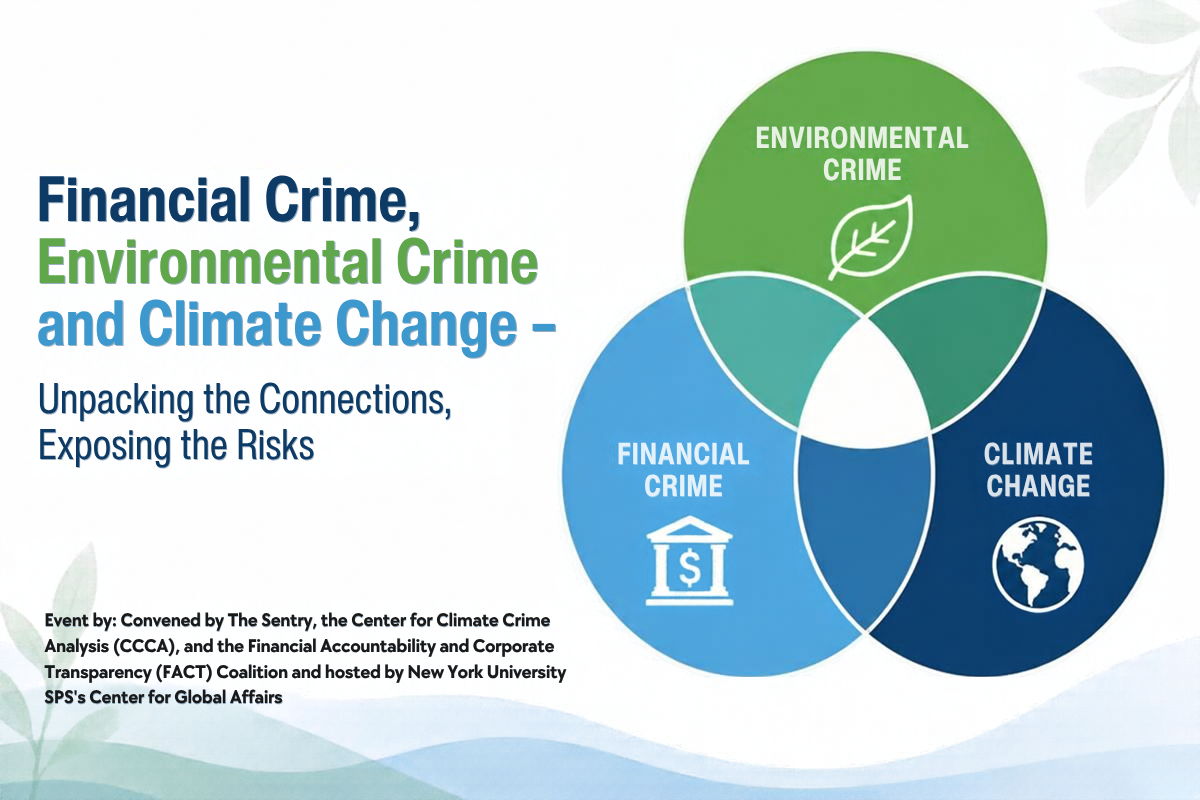
As part of Climate Week NYC 2026, Steve joined colleagues across disciplines for a dynamic discussion that explored an oft-overlooked topic: the link between financial crimes laws, environmental crime, and climate change. How — and to what extent — can financial crimes laws be useful in addressing climate harms, including those resulting from highly complex criminal environmental activity? What does this look like in practice? Where to go from here?
The panel, “Financial Crime, Environmental Crime and Climate Change – Unpacking the Connections, Exposing the Risks,” was moderated by Andrew Lehren, an investigative journalist at global environmental media outlet Mongabay. In addition to Steve, panelists included Colin Black, Executive Director of the Center for Climate Crime Analysis; Julia Yansura, Program Director for Environmental Crime and Illicit Finance at the FACT Coalition; and Justyna Gudzowska, Executive Director of The Sentry.
The FACT Coalition, an organizer alongside The Sentry and the Center for Climate Crime Analysis (CCCA), published an excellent recap of the discussion, writing:
The panel emphasized that tackling environmental crime requires looking beyond the environmental damage itself to the financial networks that facilitate it—and bringing together the expertise needed to follow those financial trails. Money laundering and other financial crimes laws provide an opportunity to address the systemic dimensions and drivers of environmental crimes. Moreover, discussants noted that while many environmental crimes have only modest penalties attached (which may not address the significant financial incentives for such crimes), investigating and pursuing the associated financial crimes often mobilizes additional investigative resources and involves significantly greater sanctions.
However, not all environmental crimes constitute “predicate offences” for money laundering charges in the United States and elsewhere. While wildlife trafficking often does, others such as illegal gold mining or illegal deforestation are not in themselves offences that can form the basis of a money laundering investigation or case in the United States. While policy and legislative reform (at the state, national, and international levels) could enhance the application of financial crimes laws to these types of environmental crime, in practice those activities often involve the commission of other offences that are predicates (such as corruption or wire fraud) that can be used to bring money laundering offences to bear.
…
In his remarks, Solow drew on his years as a state and federal prosecutor working on organized crime and environmental cases. He noted the importance of taking a problem-solving approach to the use of criminal prosecutions when investigating environmental violations. Prosecuting one person, or even a criminal group, rarely addresses the root causes that allow the wrongdoing to occur. … Solow also emphasized the importance of understanding how environmental crime affects communities, citing the problem of communities dependent upon illegal logging for sustenance and the long-term impacts of pollution events that undermine the fabric of communities. These people are also the victims of environmental crimes.
The event was held September 24 at the NYU SPS’s Center for Global Affairs, and hosted by professor David Donat Cattin in connection with his Climate Change and Human Rights course.
